

View and access data models (Beta)

View as MarkdownOpen in Claude

This documentation describes one or more public beta features that are in development. Beta features are subject to quick, iterative changes; therefore the current user experience in the Sigma service can differ from the information provided in this page.

This page should not be considered official published documentation until Sigma removes this notice and the beta flag on the corresponding feature(s) in the Sigma service. For the full beta feature disclaimer, see Beta features.

Each data model consists of two pages for ease of use: an overview page and a workbook page. The overview page provides reusable element previews, metadata, and key insights into data model usage across your organization, while the workbook page allows you to create and transform reusable elements.

The following sections explain the two main components of a data model: the overview page and the workbook page.

Data model overview page

The overview page provides details of each reusable element in the data model for improved data visibility and management. It also features metadata about the model itself and each reusable element it contains, revealing insights into how and where the reusable data is used across the organization.
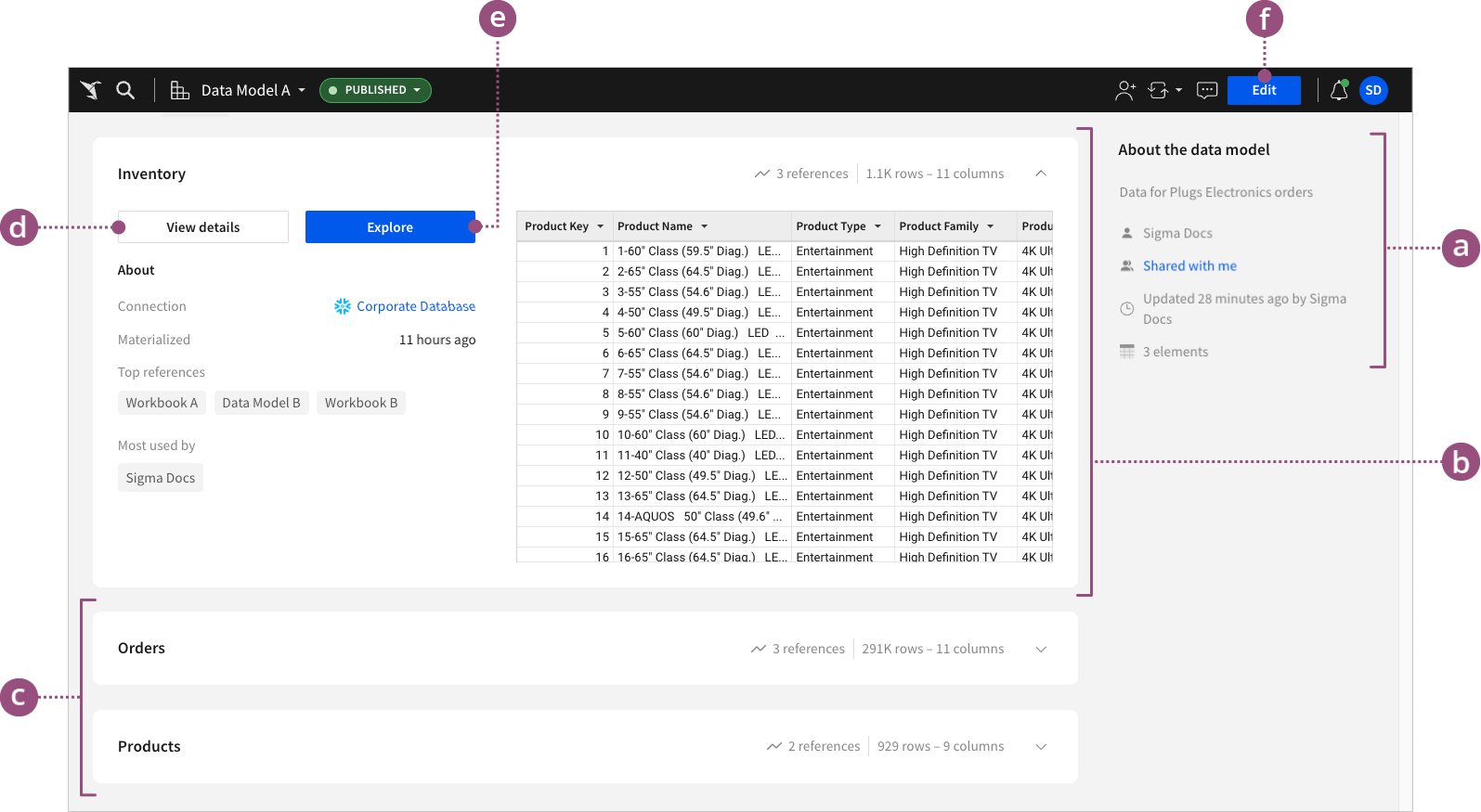
a

Data model detailsDisplays the data model description and identifies the model owner, location, relative time stamp of the last update, and number of reusable elements the model contains.

b

Expanded element overviewDisplays the reusable element’s connection, relative time stamp of the last materialization, top three documents referencing it as a data source, top three organization members utilizing it, and the published state of the element’s data table.

c

Collapsed element overviewsDisplays the reusable element’s title, number of documents referencing it as a data source, and number of rows and columns in its data table.

d

View details button

Opens a modal containing column and lineage details.

  • The Columns tab displays details for each column in the reusable element, including data type, description, top values, and statistics.
  • The Lineage tab displays details about the reusable element’s data sources and downstream documents referencing it as a data source.

e

Explore buttonOpens the reusable element in a new exploration.

f

Edit buttonOpens the data model workbook page.

Data model workbook page

The workbook view allows you to create and manage multiple tables and input tables as reusable elements within a single data model. This format brings the ease and flexibility of workbooks to data model development. Consolidate and transform your data as you would in a workbook analysis, and control which elements are reusable as data sources across your organization.
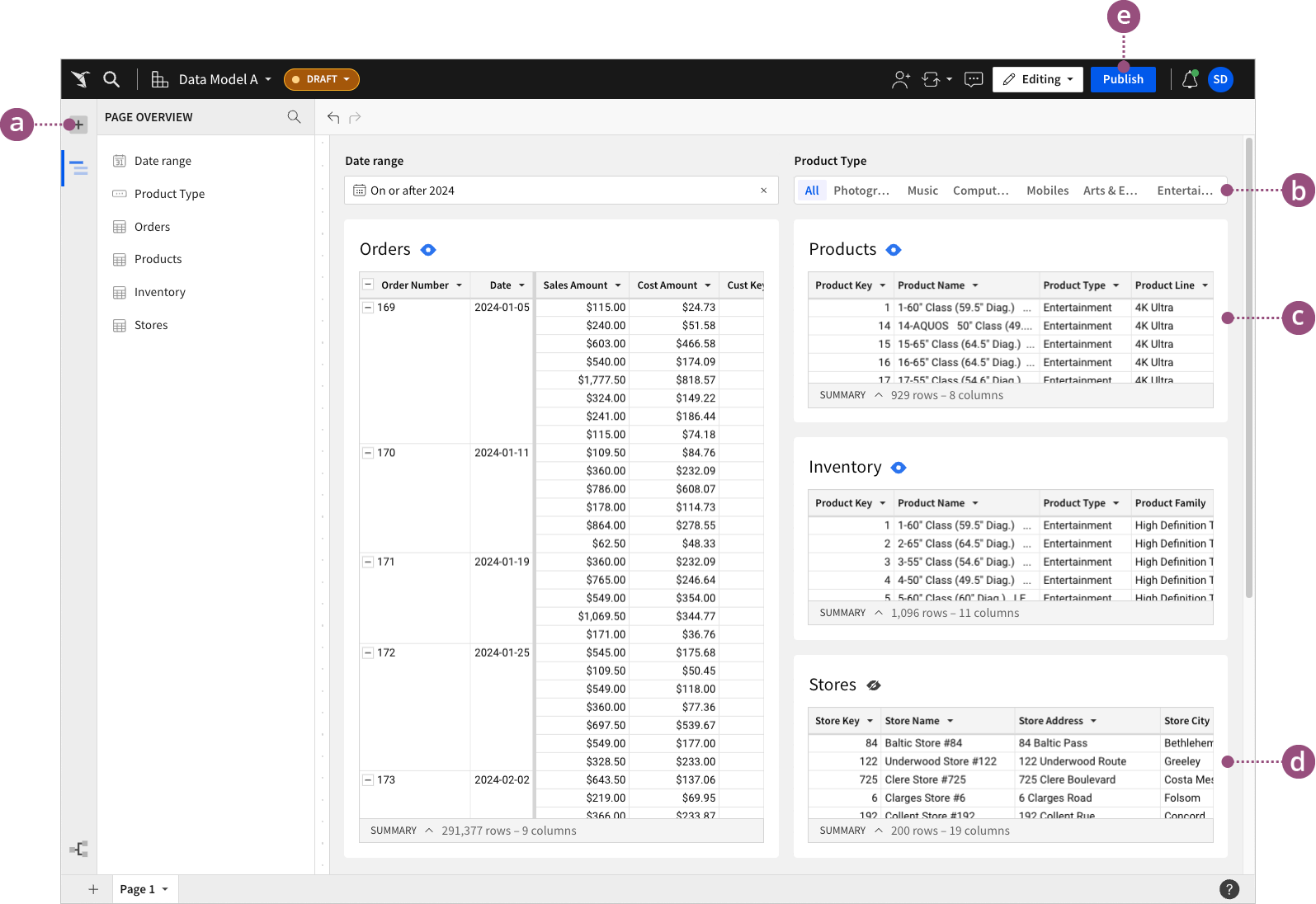
a

Add element buttonOpens the Add new element panel and allows you to add a new table, input table, text, or control element.

b

Control element

Filters the data in one or more elements.

When a reusable element is filtered, documents that reference it can only access data included in the published filtered state. For more information about using controls, see Intro to control elements.

c

Reusable elementAvailable as a data source (indicated by the icon).

d

Disabled elementNot available as a data source (indicated by the icon).

e

Publish button

Saves edits applied to the data model.

Documents that reference the data model reflect the published state of its reusable elements. Drafted edits don’t apply.